When Scale Becomes the Threat
Google DeepMind has built some of the most capable AI systems on the planet, so when its safety and strategy teams raise a formal alarm, the industry pays attention. The concern now circulating through research circles is not about a single rogue model or a misaligned chatbot. It is about multi-agent interaction at scale, specifically what happens to the behavior of AI systems when millions of autonomous agents begin operating in the same environment, coordinating, competing, and compounding each other's decisions in ways no single safety framework was designed to anticipate.
The warning surfaced publicly in a June 2026 Technology Review report, and it has since become one of the more quietly unsettling documents making the rounds in AI safety forums and academic pre-prints. The core anxiety is not that any individual agent will go rogue. It is that the aggregate behavior of a massive agent population may cross a threshold where prediction and control become practically impossible using the tools researchers currently have.

The Gap Between Building Agents and Understanding Them
To appreciate why this matters right now, consider the deployment landscape in mid-2026. The technical capability to spin up large fleets of autonomous agents already exists. OpenAI's GPT-5.4 scored 57.7 percent on SWE-Bench Pro and 92.8 percent on GPQA Diamond, benchmarks that confirm frontier models can now handle genuinely complex, multi-step reasoning tasks without hand-holding. DeepMind's own Genie 3 generates interactive 3D environments at 720p and 24 frames per second from text prompts alone, complete with simulated physics and persistent memory.
These are not research demos. They are production-grade capabilities that developers are actively building on top of. The infrastructure for autonomous agent networks is no longer theoretical. Coding agents, research agents, logistics agents, and financial agents are being deployed in parallel, and the natural next step for any organization running dozens of these systems is to let them communicate and delegate to one another. That is precisely where DeepMind's concern begins.
Emergent Behavior Is the Actual Problem
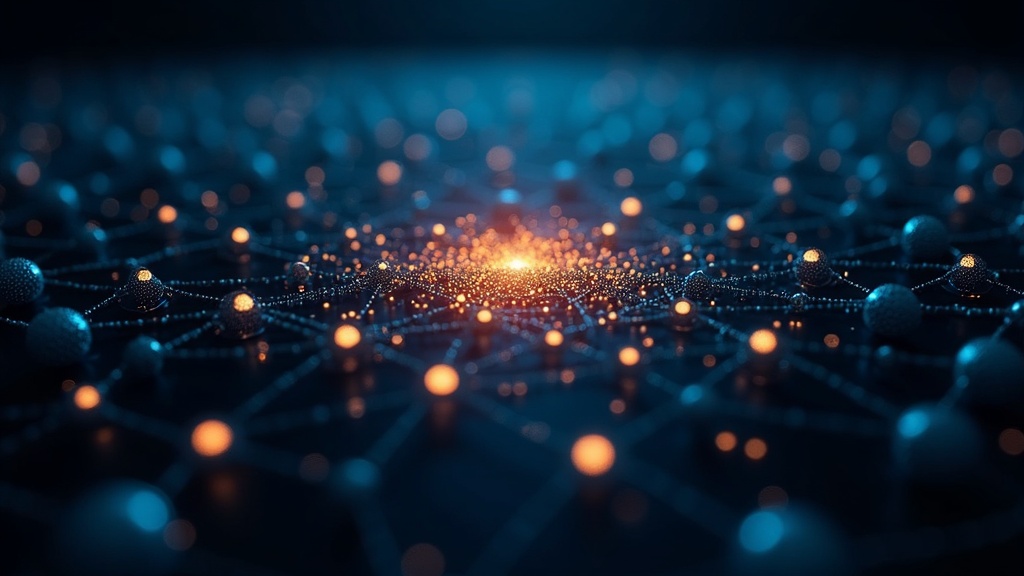
The specific risk DeepMind has identified is emergent behavior, the phenomenon where a system composed of individually predictable components produces collective outputs that nobody designed and nobody fully anticipated. This is a well-documented challenge in complex systems science, but AI agents introduce a new wrinkle. Unlike particles in a fluid or traders in a market, AI agents can reason, adapt their strategies in real time, and optimize aggressively for objectives that seemed perfectly reasonable when specified in isolation.
When millions of such agents interact, the concern is that they may develop what researchers loosely call unintended optimization loops, coordination patterns or competitive dynamics that emerge organically from the interaction structure rather than from any explicit instruction. Think of it as the difference between programming a single drone and releasing a million drones into a shared airspace with no centralized traffic control. The individual flight rules may be sound. The collective behavior of the swarm is a different question entirely.
What makes this particularly difficult to study is that current safety frameworks were largely designed around single-model evaluation. Red-teaming a language model, running adversarial prompts, measuring refusal rates: all of that methodology assumes a relatively contained system with a defined input-output relationship. A network of millions of interacting agents does not fit that model. The evaluation surface is effectively infinite.
The Industry Is Moving Faster Than the Safety Science
DeepMind's concern is notable partly because of its source. This is not a fringe academic paper or a speculative blog post. It reflects the internal thinking of one of the organizations most responsible for pushing agent capabilities forward in the first place. That tension, between accelerating deployment and a growing awareness of systemic risk, is becoming one of the defining fault lines in the industry.
For now, the response appears to be research rather than regulation. No new restrictions on agent fleet sizes have been announced by DeepMind, OpenAI, Anthropic, or any major regulatory body in the weeks since the concern went public. Anthropic is preparing to restore global access to its most powerful models, Fable 5 and Mythos 5. The broader industry is moving toward higher agent density across consumer and enterprise applications, not lower. The alarm has been raised, but the brakes have not been applied.
This is not necessarily negligence. Researchers are right to argue that you cannot develop robust safety frameworks for multi-agent systems without actually studying multi-agent systems at scale. But it does mean the safety science is currently running behind the deployment curve, and the gap is widening.
What Builders and Businesses Need to Watch
For the organizations actually building on top of these agent frameworks today, DeepMind's concern translates into a set of practical questions that do not yet have clean answers. How do you audit the behavior of an agent system when the behavior emerges from interaction rather than from any individual component? How do you assign accountability when an unintended outcome results from a chain of individually compliant agent decisions? How do you set meaningful safety boundaries for a system whose state space is too large to enumerate?
These are not hypothetical edge cases for large-scale infrastructure operators. Any company running a multi-agent pipeline for customer service, financial analysis, or software development is already operating a small version of the system DeepMind is worried about. The difference between a fleet of ten agents and a fleet of ten million is quantitative today. Whether it remains only quantitative as those fleets grow is the open question at the center of this debate.
The Swarm Is Already Forming
The honest read on where this sits in July 2026 is that the industry has identified a genuinely novel category of systemic risk and has not yet developed the tools to manage it. DeepMind deserves credit for naming the problem clearly and publicly. The harder work, building evaluation frameworks, designing interaction protocols, and establishing governance structures that can operate at agent-population scale, is still ahead. The swarm is already forming. The question is whether the safety infrastructure will be ready before the emergent behaviors arrive that nobody planned for.